
Seed application
Fertiliser placed with the seed, without the salt burn. Designed for small, fertiliser-sensitive seeds such as canola and pasture species.
Seed burn at sowing
Salt spikes on first rain
Soluble fertiliser placed with the seed dissolves on first wetting and creates a high-salt zone around the seed.
Injured seed, poor emergence
Salt stress injures the seed and leads to poor root emergence.
Small seeds most at risk
Small, slow-germinating seeds such as canola and pasture species are most at risk, especially under dry sowing.
What happens at sowing
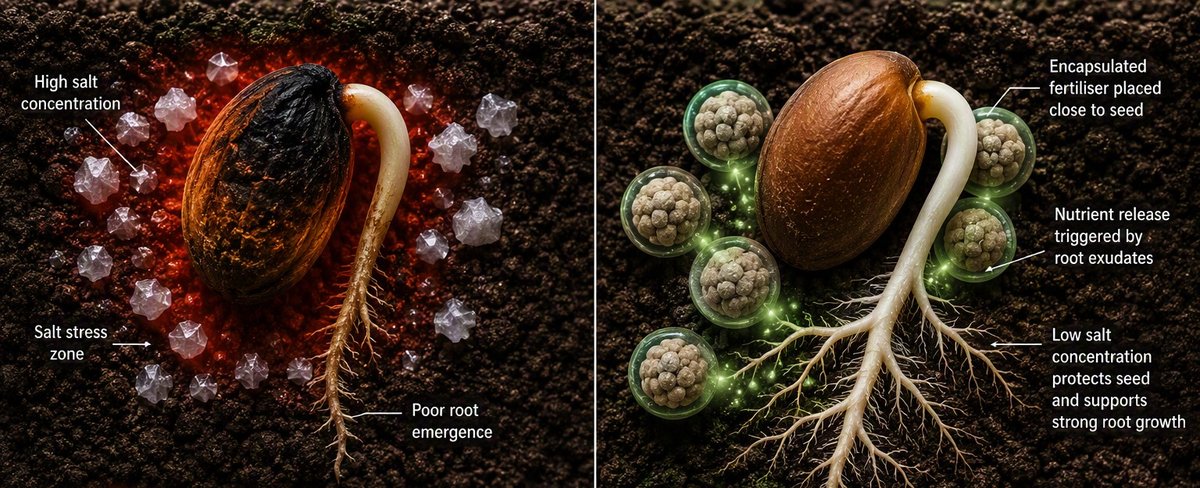
- Dissolves on first wetting and creates a high-salt zone around the seed.
- Salt stress injures the seed and leads to poor root emergence.
- Small, slow-germinating seeds such as canola and pasture species are most at risk.
- Placed close to the seed with low salt concentration, so the seed is protected.
- Nutrients are released when roots exude organic acids, supporting strong root growth.
- In laboratory tests, canola germination was preserved.
Held at sowing, released when roots call
Sowing and first rain
Release is negligible on first contact with water, so no salt burst forms around the seed.
Roots emerge and exude organic acids
The organic acids lower the local pH around the fertiliser.
Nutrients follow the root
This root signal triggers P and N release, supporting strong root growth.
What we have shown so far
| Test | Commercial TSP | NanoSoils |
|---|---|---|
| Canola germination with fertiliser at the seed | Seed injury | Germination preserved |
Related seed trials
For growers and seed suppliers
Canola
Small, slow-germinating seed that is sensitive to fertiliser at sowing.
Pasture species
Small seeds that are most at risk of seed burn, especially under dry sowing.
Seed and fertiliser suppliers
A seed-safe way to place fertiliser close to the seed.
Trial it with your seed
Joint evaluations on your own crop, with field trial partnerships from 2027.